

Table of Contents
Tsunami Awareness Week
The Importance of Tsunami Awareness Week for Public Safety
Every year, from March 24 to 30, the United States observes National Tsunami Awareness Week. This important initiative raises public awareness about the causes and impacts of tsunamis and highlights how individuals, organizations, and communities can prepare to reduce risk and save lives.
While many people associate tsunamis with places like Southeast Asia, fewer realize that these events can impact multiple regions across the U.S., including Alaska, Washington, and U.S. Caribbean territories. Tsunami Awareness Week is an opportunity to educate yourself, your colleagues, and your community so everyone is better prepared to respond quickly and safely.
In this blog, we’ll explore the history of tsunamis in the U.S., the importance of early warning systems, and how modern emergency notification platforms play a critical role in mitigating damage and protecting lives.
History of Tsunamis in the U.S.
A common misconception is that tsunamis primarily affect other parts of the world. In reality, the United States has experienced several significant tsunami events.
The largest recorded tsunami occurred in Lituya Bay, Alaska, in 1958, generating waves reaching an astonishing height of 1,720 feet. Additionally, the 1946 Aleutian Islands tsunami caused widespread destruction and remains one of the most economically damaging tsunami events in U.S. history.
Although tsunamis are less frequent than other natural disasters, they can occur at any time of year and often with little warning, making awareness and preparedness critical.
Regions facing the highest tsunami risk include:
- Alaska
- California
- Hawaii
- Washington
- U.S. Caribbean territories (including Puerto Rico and the Virgin Islands)
A Recent Reminder of Tsunamis’ Global Threat
On July 29, 2025, a powerful magnitude 8.8 (Mw) earthquake struck offshore the Kamchatka Peninsula, Russia, triggering a tsunami observed across the Pacific Ocean Basin. Warnings and watches spread throughout coastal areas along the Pacific Rim, including in Alaska and the Pacific Northwest coast of the United States. Preliminary reports recorded tsunami wave heights of 55 – 65 feet in parts of southeast Kamchatka and the Northern Kuril Islands in the area between Russia and Japan.
This event serves as a stark reminder that large-scale tsunamis can impact regions far beyond their origin, and that rapid detection, communication, and preparedness are critical for minimizing harm. As additional data continues to be analyzed and published, events like this reinforce the importance of robust global and regional warning systems.
The Importance of Early Warning Systems
Tsunami early warning systems are essential for saving lives. These systems detect seismic activity and ocean changes, allowing authorities to issue alerts before waves reach shorelines.
The devastating Indian Ocean tsunami on December 26, 2004, which tragically claimed more than 225,000 lives, underscored the urgent need for coordinated global warning systems. In response, international organizations — including the United Nations — accelerated efforts to develop comprehensive early warning frameworks for natural hazards.
Today, early warning systems not only detect potential tsunamis but also rapidly disseminate critical information so individuals and communities can take immediate protective action.
In the United States, the National Tsunami Warning Center (NTWC) works closely with the National Oceanic and Atmospheric Administration (NOAA) to monitor seismic activity and issue tsunami alerts.
Official Federal alerting systems channels include:
- Wireless Emergency Alerts (WEA)
- The Emergency Alert System (EAS)
- NOAA Weather Radio
- Television and radio broadcasts
- Marine radio systems
Following the 2004 disaster, the National Weather Service (NWS) and the National Tsunami Hazard Mitigation Program (NTHMP) launched the TsunamiReady® program. This initiative helps communities improve preparedness through education, planning, and coordination with emergency management agencies.
The Role of Mass Notification Systems
The official Federal alerting systems listed above help spread the word about tsunami danger, but how do local governments, healthcare organizations, businesses, and educational institutions spread the word to keep their people safe? This is where mass notification systems like Regroup can play a critical role in empowering organizations of all sizes to amplify the message and reach anyone who might be in harm’s way.
Since 2006, Regroup has provided a secure, cloud-based platform that enables organizations to send critical alerts within seconds. Here’s an example scenario demonstrating how a system like Regroup’s would be used to save lives:
1. Underwater Earthquake Detected – Federal systems detect an underwater earthquake powerful enough to trigger a tsunami that could impact American coastlines.
2. Official Alerting Systems are Triggered – Systems within National Weather Service (NWS), National Oceanic and Atmospheric Administration (NOAA), and National Tsunami Hazard Mitigation Program (NTHMP) trigger alerts through channels like NOAA Weather Radio. These systems typically alert first responders and emergency management authorities.
3. Mass Notification Systems Notify the Broader Public – County governments, higher education institutions, healthcare organizations businesses, and other organizations that use Regroup can pre-configure the system to receive NWS/NOAA alerts and automatically distribute them to citizens. Alerts can be automatically delivered to anyone subscribed to receive notifications, or emergency managers can choose to filter and send their own alerts to segmented audience groups based on location or other factors.
During a tsunami or other large-scale emergency, traditional communication methods can fail due to power outages, network disruptions, or evacuations. This makes reliable, multi-channel communication essential. A modern mass notification system like Regroup’s enables organizations to quickly reach people wherever they are across multiple devices and communication channels, even when infrastructure is compromised.
Key features that make Regroup stand out to emergency managers include:
- Geofencing: Target alerts to specific geographic areas and automatically notify individuals entering or leaving designated zones.
- NOAA & NWS Integration: Automatically deliver real-time, location-based weather alerts, including tsunami warnings, watches, and alerts.
- IPAWS Integration: Authorized government entities (like cities and counties) can use Regroup to distribute alerts using FEMA’s Integrated Public Alert & Warning System.
- Threat Intelligence (TX360): Monitor emerging risks 24/7 to maintain situational awareness and business continuity.
With these tools, organizations can activate emergency response plans quickly, keep people informed, and coordinate effectively during and after a crisis.
Case Study: Regroup Partners with the Puerto Rico Seismic Network (PRSN)
The Puerto Rico Seismic Network (PRSN), a leading authority in seismic monitoring and tsunami warning for the Caribbean, partnered with Regroup to strengthen its emergency alerting capabilities.
During its Caribe Wave tsunami preparedness exercise, PRSN integrated Regroup’s mass notification platform into its early warning workflows. In simulated earthquake scenarios, seismic activity detected across PRSN’s monitoring stations automatically triggered alerts through Regroup, ensuring rapid communication to emergency officials and first responders throughout the Caribbean.
This integration demonstrated several key advantages:
- Automated alerting: Seamless connection between seismic detection systems and communication workflows enabled faster response times.
- Multi-channel delivery: Alerts were successfully delivered via text, voice, and email, improving reach and reliability.
- Operational readiness: Emergency distribution lists allowed PRSN to quickly notify hundreds of stakeholders responsible for response and rescue efforts.
- Real-time analytics: Reporting tools provided visibility into message delivery and engagement, allowing teams to adapt and improve communication strategies.
Prior to adopting Regroup, PRSN faced challenges with message delivery reliability and lacked visibility into alert effectiveness. With Regroup, the organization gained a dependable, fully integrated communication system that supports both preparedness drills and real-world emergencies.
As PRSN Director Angel Feliciano emphasized:
“A mass notification platform like Regroup is key to minimizing the damage from catastrophic events such as tsunamis. Unlike big earthquakes, which are impossible to predict, we can analyze tsunami-prone areas and alert people right after an earthquake before the tsunami occurs. It provides valuable time for people to get to safety and for emergency personnel to prepare for their response.”
Angel Feliciano, Director – Puerto Rico Seismic Network
This case study reinforces Regroup’s position as a leader in tsunami warning communications, trusted by seismic networks and emergency management organizations to deliver critical alerts when every second counts.
Want to learn more?
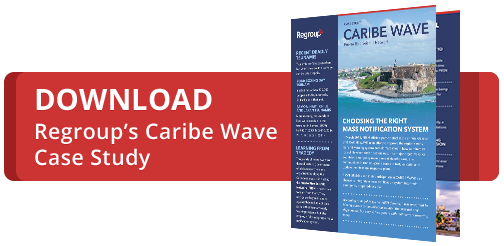
Read the full Puerto Rico Seismic Network case study today:
Closing
Natural disasters like tsunamis pose serious risks to lives, infrastructure, and communities. Having the right tools and a well-defined emergency communication plan is essential for minimizing harm.
Relying on Federal alerting channels to reach broad swaths of the population is insufficient. Organizations in coastal areas need a reliable mass notification system to deliver timely, actionable information when it matters most. By ensuring clear communication before, during, and after an event, organizations can significantly improve safety outcomes.
Preparation is key. By combining awareness, planning, and technology, your organization can stay resilient in the face of uncertainty.
Learn how Regroup Mass Notification can help protect your people and operations. Take a virtual tour of our platform to see it in action today.
Table of Contents
Categories
- Business
- Transportation
- Small Business
- Manufacturing
- Banking Finance
- Disaster Recovery
- Employee Safety
- Routine Communications
- Mass Notification
- Critical Event Management
- Emergency Preparedness
- Corporate
- Insurance
- Business Continuity
- Business Case Studies
- Uncategorized
- Education
- Regroup Product Guides
- Nonprofit
- Healthcare
- Hospitality
- Government & Public Services
- Our Clients
- Awards
- Blog
- COVID-19
- Safety & Preparedness
- News
- Announcements