

Table of Contents
- Mass Notification Has Long Supported Hospital Code Alerting
- The Problem with Traditional Color Code Systems
- Why Mass Notification Is Critical to This Transition
- Supporting a New Era of Healthcare Resilience
- Unlocking the Full Potential of Mass Notification
- The Future of Healthcare Emergency Communications
From Code Blue to Plain Language: How Hospitals Are Modernizing Emergency Alerting
For decades, hospitals have relied on emergency codes such as Code Blue, Code Red, and Code Silver to rapidly communicate critical incidents and mobilize response teams.
While these codes remain a foundational part of healthcare emergency management, the way hospitals communicate during emergencies is evolving. Growing concerns around workplace violence, cybersecurity disruptions, operational resilience, and workforce mobility are driving healthcare organizations to rethink how emergency information is delivered — and to whom.
Mass Notification Has Long Supported Hospital Code Alerting
Hospitals have used notification technologies to distribute alerts associated with medical emergencies, fires, security threats, hazardous material incidents, and disaster response events. What began as overhead paging and call trees has given way to multi-channel platforms that can reach staff across whole facilities, campuses, and health systems in seconds.
Today, a Code Blue may automatically notify rapid response teams and nearby clinicians, while a Code Silver activation can simultaneously alert security personnel, hospital leadership, and emergency management teams.
Either way, the point remains the same, get the information out fast enough that the right people can act on it.
The Problem with Traditional Color Code Systems
One challenge facing healthcare organizations is that emergency code meanings are not standardized across the industry. Instead, they have different meanings across states, facility types, and even within the same healthcare network.
According to Campus Safety Magazine, a 2023 survey was sent to over 300 employees at 5 different Georgia healthcare facilities asking them to identify the codes for 14 different emergencies. On average, participants incorrectly identified the color code meaning 56% of the time, and many commented that the codes were not practiced regularly at their facilities.
As an example, a Code Pink may indicate infant abduction in one facility and a pediatric emergency in another. After a tragic incident where 3 people were shot at a healthcare facility in California, it was found that hospitals in the state were using 47 different codes for infant abduction, and 61 for a combative person. Sadly, the code that had been issued drew people toward an active shooter. The incident prompted the Hospital Association of Southern California (HASC) to release a handbook in 2000 as a guide for standardizing healthcare emergency codes.
As healthcare systems increasingly rely on traveling clinicians, contractors, regional partnerships, and multi-campus operations, inconsistencies can create confusion during time-sensitive events. This has fueled industry discussions around standardization and the use of plain-language alerts that clearly describe an incident rather than relying solely on color codes.
Instead of hearing:
“Code Silver, Main Lobby”
Staff may receive:
“Active Shooter Reported in Main Lobby – Initiate Lockdown Procedures.”
Some health systems aren’t waiting for a state mandate to make the change: In 2019, Piedmont Healthcare moved to plain-language alerts across its 11 hospitals in Georgia. Piedmont Newton Hospital CEO, Eric Bour, pointed to the same core problem outlined above: codes that worked fine within a single facility became a liability once staff moved between hospitals, since a color that meant one thing at their home facility could mean something entirely different somewhere else.
Piedmont isn’t alone — several states, including Minnesota, Iowa, Texas, North Carolina, and, most recently, Washington, have introduced plain-language alert recommendations in recent years, even though there’s still no single national standard in place. The idea is to leave less room for confusion when a response can’t wait.
Why Mass Notification Is Critical to This Transition
As hospitals explore plain-language communications and standardized emergency response procedures, mass notification systems have become increasingly important.
Unlike traditional paging systems, modern notification platforms can deliver detailed, incident-specific information through multiple channels, including mobile devices, SMS, desktop alerts, email, digital signage, voice communications, among others.
More importantly, they allow hospitals to target messages based on role, department, responsibility, or location. This means organizations can move beyond broad facility-wide alerts and deliver actionable information directly to those responsible for responding.
Supporting a New Era of Healthcare Resilience
Hospital emergency communications now extend far beyond traditional emergency codes.
The same platforms used for code alerting are increasingly supporting:
- Workplace violence response
- Staff duress alerting
- Cybersecurity incident communications
- Severe weather notifications
- Facility disruptions
- Staffing shortages
- Infectious disease events
- Business continuity and disaster recovery operations
- Routine announcements
- Day-to-day operational notifications
Emergency communication is no longer just a safety feature, it’s becoming part of how hospitals stay operational every day.
Unlocking the Full Potential of Mass Notification
Many healthcare organizations already have mass notification systems in place to support emergency code alerting and incident communications. The real gain now is getting more out of what’s already there.
- Targeted Alerting
Modern mass notification platforms enable healthcare organizations to deliver alerts based on responsibility, department, shift, credential, or physical location. By leveraging group-based targeting, GIS mapping, indoor positioning technologies, and staff location services, hospitals can identify and notify the personnel closest to an incident, ensuring faster response times and more efficient resource utilization.
- Automated Response Workflows
During an emergency, speed and consistency are critical. Notification systems should do more than simply distribute messages; they should help orchestrate response efforts.
Healthcare organizations can accelerate incident response through automated workflows that include:
- Pre-configured emergency alert templates
- Escalation paths for unacknowledged alerts
- Read and acknowledgment tracking
- Incident-specific response instructions
- Automated follow-up communications
Rather than relying on manual phone calls and departmental coordination, authorized staff can initiate a complete response workflow from a single platform, reducing delays and helping standardize emergency procedures across facilities and campuses.
- Integrated Security and Incident Management
As workplace violence and security threats continue to rise, healthcare organizations are increasingly investing in incident management platforms that provide a centralized environment for managing incidents from detection through resolution.
By integrating mass notification systems with access control, video surveillance, duress solutions, and emergency management technologies, incident management features enable healthcare leaders to coordinate response activities, track actions, monitor incident status, and maintain situational awareness.
This centralized approach helps hospitals move beyond reactive communications toward a more coordinated, accountable, and efficient incident response process, improving decision-making and operational resilience during critical events.
- Mobile-First Communications
Healthcare workers are increasingly mobile, often moving across departments, buildings, and campuses throughout their shifts. Many travelling or part-time care team staff also frequently work at multiple facilities spread between different locations and care networks all within the same week.
Mobile applications, smartphones, wearable devices, and push notifications allow staff to receive, acknowledge, and respond to emergency alerts regardless of their location. This mobile-first approach ensures critical communications reach frontline personnel quickly and supports more effective coordination during rapidly evolving incidents.
- Operational Continuity
Every healthcare facility will likely experience an emergency or incident at some point. Alerting people and keeping them safe is the highest priority, but responding to it and getting back to normal operations is the most critical next step. Patients still need care, and teams need to be able to return to operation quickly to provide high standards of care and avoid compounding issues.
With a mass notification system like Regroup in place, security and operations teams can coordinate their responses to address and resolve any incident faster. They’re also able to issue all-clear alerts or other important updates to put staff and patients at ease and enable teams to get back to work quickly.
Operational continuity can be further supported by expanding emergency communications beyond life-safety events to include cyber incidents, IT outages, and other operational disruptions. Mass notification systems should be integrated into cybersecurity and business continuity plans to help hospitals maintain reliable communications during system outages, ransomware attacks, and technology disruptions.
For healthcare leaders, the value of mass notification extends beyond rapid alert delivery. These platforms support decision-making, improve coordination, and help maintain operational continuity during both emergency and non-emergency events.
The Future of Healthcare Emergency Communications
The future of healthcare communication is not just about eliminating or even standardizing emergency color alerting codes. It is about providing clearer, faster, and more actionable information during critical events. As healthcare organizations continue to standardize terminology, adopt plain-language communications, and integrate security and operational technologies, mass notification systems will play an increasingly strategic role.
The most effective healthcare organizations will be those that view mass notification not simply as a color code alerting tool, but as a communication platform that supports patient safety, staff protection, incident response, and organizational resilience. In the coming years, the organizations best prepared for emergencies may not simply be those with the strongest response plans, but those with the ability to communicate effectively, instantly, and intelligently when every second matters.
Evaluate your hospital’s readiness to communicate during critical events with the Regroup Hospital Emergency Communications Assessment. Download it now!
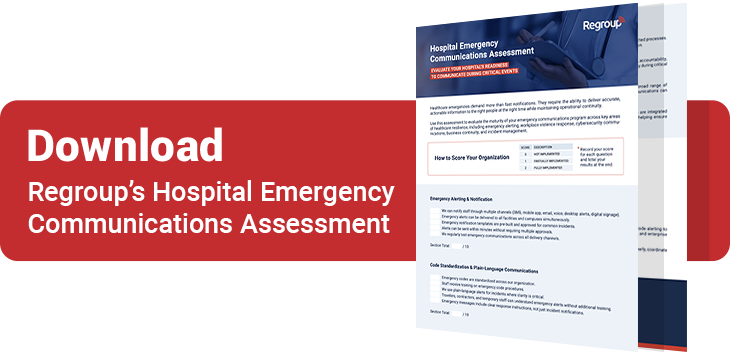
Table of Contents
- Mass Notification Has Long Supported Hospital Code Alerting
- The Problem with Traditional Color Code Systems
- Why Mass Notification Is Critical to This Transition
- Supporting a New Era of Healthcare Resilience
- Unlocking the Full Potential of Mass Notification
- The Future of Healthcare Emergency Communications
Categories
- Business
- Transportation
- Small Business
- Manufacturing
- Banking Finance
- Disaster Recovery
- Employee Safety
- Routine Communications
- Mass Notification
- Critical Event Management
- Emergency Preparedness
- Corporate
- Insurance
- Business Continuity
- Business Case Studies
- Uncategorized
- Education
- Regroup Product Guides
- Nonprofit
- Healthcare
- Hospitality
- Government & Public Services
- Our Clients
- Awards
- Blog
- COVID-19
- Safety & Preparedness
- News
- Announcements