

How to Build an Emergency and Crisis Communication Plan for Today’s Risk Environment
When a crisis unfolds, your response team may have only minutes to communicate accurate information, give people clear instructions, and establish your organization as a trusted source.
Cyber incidents and technology outages now sit alongside severe weather and physical threats as common reasons to activate crisis communications. Meanwhile, AI-generated misinformation, fragmented media channels and rapidly evolving online narratives can shape what people believe about an incident before an organization releases its first official statement.
For crisis response teams, a well-developed emergency and crisis communication plan can make the difference between scrambling to respond and executing a coordinated communications strategy. The strongest plans don’t treat emergency alerts as a separate system bolted on for worst-case scenarios — they build crisis readiness into the same fast, reliable channels a team already uses for day-to-day updates, so nothing new has to be learned under pressure.
What Is a Crisis Communication Plan?
A strong plan needs to be actionable under pressure. That means going beyond high-level policies and establishing procedures your team can actually follow.
- Clear Activation Levels
Not every incident requires the same communications response. Organizations can establish activation levels that scale according to the scope and impact of an incident. A developing situation might initially require monitoring and internal coordination, while a major emergency could trigger organization-wide notifications, executive involvement, public communications, and ongoing updates.
Defining those thresholds in advance helps crisis response teams understand when communications should escalate — and it works both ways. The same tiered structure that scales up for a major emergency can also scale down for routine notices, like a scheduled system update or a policy change, so teams always respond proportionately to the activation level of each event.
- Defined Roles and Decision Authority
Who can send an emergency notification? Who verifies the facts? Who approves a public statement? Those questions should not be answered for the first time during an incident.
Organizations should establish who has authority to issue communications and assign primary and backup personnel to critical roles. Depending on the organization, that may include an emergency manager, incident commander, communications lead, spokesperson, legal or compliance advisor, technical subject-matter experts, or even executive leadership.
- Audience and Channel Strategy
Employees, executives, families, customers, the public and the media do not necessarily need the same information or receive it through the same channels.
An effective emergency communication plan identifies which audiences need to be reached and matches them with appropriate channels, including SMS/text, email, voice, mobile apps, intranets, social media and other established communication methods. A multi-channel approach ensures no one is left uninformed simply because they weren’t checking one particular channel. One built on Mass Notification Software like Regroup’s can reach every audience at scale, whether it’s an evacuation notice or a routine staffing update
- A Strategy for Ongoing Crisis Communications
As an incident develops, crisis response teams may need to issue situation updates, request acknowledgments, provide operational instructions, communicate recovery information, and eventually issue an all-clear. Your crisis communication plan should establish how communications will continue throughout the incident rather than focusing exclusively on the initial notification.
- A Process for Verification and Misinformation
Speed matters, but so does accuracy. This balance is particularly important when teams encounter information originating from social media or AI-generated summaries. Before unconfirmed information shapes an official alert, teams should identify the original source, seek independent corroboration, verify relevant media and cross-check claims against trusted internal information. Building verification procedures into the plan can help teams respond quickly without sacrificing credibility.
- Testing and Continuous Improvement
Exercises can help organizations evaluate communication speed, message clarity, approval workflows, technology performance and coordination across teams. After-action reviews can then identify gaps and turn lessons learned into improvements to plans, templates, training, and communication strategies.
Organizations that already rely on their notification platform for everyday operational updates tend to run smoother emergency exercises. Teams are already comfortable with the tools, so testing can focus on decision-making and message clarity rather than relearning the technology itself.
Prepare Your Crisis Response Team Before the Next Incident
Building a resilient crisis communication program means establishing clear procedures, defining responsibilities, training personnel, exercising the plan, and evaluating performance before a critical event occurs.
Our Emergency & Crisis Communications Guide takes a deeper look at how organizations can prepare. The guide includes practical strategies, example frameworks, and planning considerations covering activation levels, roles and responsibilities, audience and channel strategy, communications throughout an incident, recovery, performance measurement, and the emerging role of AI in crisis communications.
Download the Emergency & Crisis Communications Guide to evaluate your current approach, identify potential gaps and build a crisis communication plan your response team can put into action when every minute matters
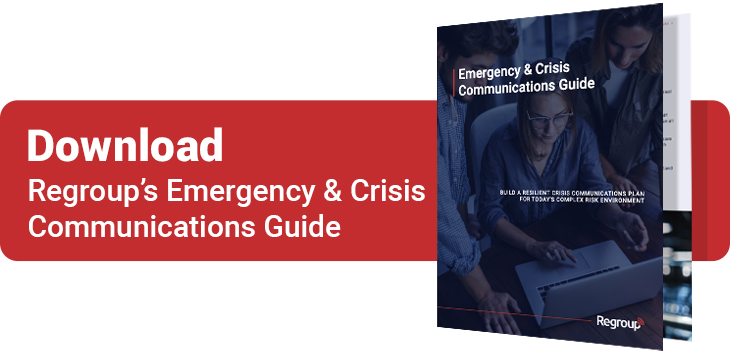
Table of Contents
Categories
- Business
- Transportation
- Small Business
- Manufacturing
- Banking Finance
- Disaster Recovery
- Employee Safety
- Routine Communications
- Mass Notification
- Critical Event Management
- Emergency Preparedness
- Corporate
- Insurance
- Business Continuity
- Business Case Studies
- Uncategorized
- Education
- Regroup Product Guides
- Nonprofit
- Healthcare
- Hospitality
- Government & Public Services
- Our Clients
- Awards
- Blog
- COVID-19
- Safety & Preparedness
- News
- Announcements