

Table of Contents
- Priority #1: Knowing What to Do
- Priority #2: Getting Information Quickly
- Priority #3: Clear Instructions, Not More Noise
- Priority #4: Knowing the Organization Can Hear Them, Too
- Priority #5: Confidence That the Plan Has Been Practiced
- What Does Employee-Centered Preparedness Look Like?
- Employee Safety Is a Communication Challenge
- Are Your Employees Getting What They Need to Feel Prepared?
Employee Safety: What Are Your Employees’ Priorities?
Although organizational strategies for workplace safety generally focus on compliance, strategic emergency plans, protocols, and technological infrastructure, staff members often see the situation from a very different perspective.
In the midst of a crisis, employees who aren’t emergency management personnel shift their priorities to urgent, practical concerns: What’s happening? Is my safety at risk? What steps should I take? Should I move locations? How will I get updates as this unfolds, and from who/where?
By recognizing and proactively addressing these fundamental needs, organizations can develop a practical safety framework that operates effectively during real-world crises rather than just serving as a conceptual document.
Priority #1: Knowing What to Do
An emergency action plan has limited value if employees don’t understand how to use it.
Workplace preparedness requires more than creating procedures. Employees need information about emergency plans, evacuation procedures, and their individual responsibilities. Safety experts consistently emphasize the importance of involving both management and employees in planning and response, not just documenting a plan and filing it away.
That means preparedness plans should answer practical questions employees are likely to have:
- Where should I go?
- What evacuation route should I use?
- Who is responsible for what?
- How will I receive instructions?
- What should I do if normal procedures cannot be followed?
Experts in emergency management similarly recommend identifying notification procedures, evacuation routes, gathering locations, roles and responsibilities, and the training employees will need as part of workplace emergency planning.
For employers, the takeaway is simple: A plan becomes more valuable when employees understand their place in it, and that clarity should be reinforced through day-to-day communication, not just reviewed once a year during a compliance check.
Priority #2: Getting Information Quickly
In an emergency, uncertainty itself can become a significant hazard. For effective workplace safety, employees require swift, dependable communication that keeps them informed about the unfolding situation and the specific steps they need to take.
A mass notification system can help organizations distribute critical information across multiple channels rather than relying on a single method of communication. Regroup can support notifications through channels including SMS/text, email, WhatsApp, push notifications, desktop alerts, PA systems, and more.
This multichannel approach is especially important because employees are not always sitting at a desk. Depending on the organization, they may be working on a production floor, traveling, working remotely, operating in the field, or moving between locations. The same channels that carry an urgent evacuation notice on a Tuesday afternoon can carry a routine shift change or policy reminder the rest of the week.
The system needs to be reliable enough to trust in both situations, and flexible enough to reach the right people with the right level of urgency to meet the situation at hand. The true goal is not merely to transmit an emergency notification, but to guarantee that the right individuals get the information quickly enough to take action when it matters most.
Priority #3: Clear Instructions, Not More Noise
Speed matters, but a fast alert that leaves employees wondering what to do next actually creates a larger communication problem that can make an urgent situation worse. Effective safety communication should help employees understand the situation and the action expected of them.
Pre-built, editable message templates — like the pre-configurable templates in Regroup’s system — are designed to help organizations prepare information that can be updated and distributed rapidly during an incident, without staff scrambling to draft language in the moment. Organizations can also target communications to specific groups or locations, such as departments, building floors, or job sites.
That capability can help organizations move from broad warnings toward more relevant instructions. Instead of everyone receiving the same generic message, the goal should be to provide useful, targeted information to the people who need it, whether that’s a lockdown instruction for one building or a routine maintenance notice for one shift.
Priority #4: Knowing the Organization Can Hear Them, Too
Communication during emergencies shouldn’t be a one-way street. Staff members might require a way to share updates on their safety, request help, or relay critical information about evolving situations.
Two-way messaging capabilities can provide real-time status updates and help organizations check on employee safety during emergencies — and the same channel can be used day-to-day for shift check-ins or incident reporting.
Employee safety capabilities can extend beyond notifications as well, including panic alerts, lone-worker check-ins, geolocation, health and safety updates, incident reporting, and secure tracking for lone workers.
Combined, these features solve a critical problem: facilitating two-way dialogue when staff require assistance. Such tools are especially vital for lone workers or field personnel operating outside the safety of a standard office environment.
Priority #5: Confidence That the Plan Has Been Practiced
For most employees, upcoming emergency drills are rarely something to look forward to, given how they disrupt regular workflows and can feel repetitive. Descending numerous flights of stairs only to wait around outside for an all-clear signal often feels completely disconnected from the day-to-day realities of their actual jobs.
That resistance does not make drills less important. It makes it even more important to conduct them efficiently and using realistic scenarios.
Regular drills and training are essential because employees need to know how to put an emergency action plan into practice. Workplace safety research has found that employees who take part in structured emergency-preparedness training report a stronger sense of their organization’s readiness than those who don’t — a reminder that preparedness efforts pay off when management and employees train together and tailor exercises to the workplace’s actual operations and risks.
When employees view drills as a disruption, the solution is not to increase their frequency, but to improve their quality. Exercises should be designed around realistic scenarios that prompt employees to think critically about their actions. This means assigning meaningful roles, grounding the events in situations they might actually face, and evaluating communication systems alongside evacuation protocols.
Following the exercise, the organization should clearly explain the insights gained and the subsequent changes that will be implemented. This approach transforms a drill from a mere interruption into clear evidence of a genuine commitment to workforce safety.
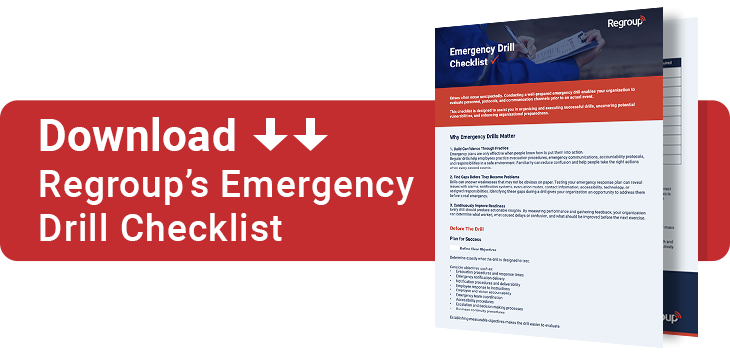
Regroup created an Emergency Drill Checklist to help organizations plan, conduct and evaluate exercises more effectively.
Use it to prepare your teams, test critical communication procedures and identify opportunities to strengthen your emergency response.
Download the Emergency Drill Checklist Here
Priority #6: Communication Before an Emergency Happens
Employee safety should not begin when an alarm sounds. Communication can reinforce safety during normal operations as well.
A mass notification platform can distribute training reminders, policy updates, and safety tips just as easily as it delivers an emergency alert. Mobile capabilities can also allow employees to report concerns such as equipment problems, unsafe conditions, or suspicious activity — long before those concerns become incidents.
This creates an opportunity to make safety communication part of everyday operations rather than something employees encounter only during a crisis. The same infrastructure that keeps people informed and safe during an emergency is the one they should already be used to hearing from, with the caveat that certain channels may only be activated during emergencies.
The same principle applies to preparedness itself. Workplace safety procedures should be communicated clearly, regularly reviewed, and updated as risks and operations change.
What Does Employee-Centered Preparedness Look Like?
To effectively assess your employee safety strategy, shift your focus away from the organization’s viewpoint and examine it from the perspective of your workforce.
Ask whether your people can:
- Understand
Do employees know the emergency plan and their role in it?
- Receive
Can you reach them quickly and reliably wherever they are?
- Act
Are your instructions specific enough for employees to know what to do next?
- Respond
Can employees report their status or ask for assistance?
- Practice
Are drills relevant enough to prepare employees for realistic situations?
- Trust
Have you demonstrated that employee safety is an ongoing organizational priority, not just an emergency-day concern?
If the answer to any of those questions is unclear, there may be an opportunity to strengthen your preparedness strategy.
Employee Safety Is a Communication Challenge
Emergency preparedness requires planning, training, and defined responsibilities. But when something actually happens, those elements depend on communication.
Employees need to know there is a problem. They need to understand what to do. Organizations need reliable, fast ways to reach people across locations and channels — for both the emergency alert and the routine update. And in many situations, safety teams need information back from employees.
That is where mass notification becomes more than an alerting tool — it becomes part of a broader employee safety strategy, one that works the same way on a quiet Wednesday as it does during a crisis.
Regroup Mass Notification helps organizations keep employees informed and safe with emergency alerts, day-to-day updates, multichannel notifications, two-way communication, and employee safety capabilities designed to support communication before, during, and after critical events.
Are Your Employees Getting What They Need to Feel Prepared?
The question is not simply whether your organization has an emergency plan.
It is whether your employees can rely on that plan when it matters most.
See how Regroup can help you build a more connected, informed, and prepared workforce.
Table of Contents
- Priority #1: Knowing What to Do
- Priority #2: Getting Information Quickly
- Priority #3: Clear Instructions, Not More Noise
- Priority #4: Knowing the Organization Can Hear Them, Too
- Priority #5: Confidence That the Plan Has Been Practiced
- What Does Employee-Centered Preparedness Look Like?
- Employee Safety Is a Communication Challenge
- Are Your Employees Getting What They Need to Feel Prepared?
Categories
- Business
- Transportation
- Small Business
- Manufacturing
- Banking Finance
- Disaster Recovery
- Employee Safety
- Routine Communications
- Mass Notification
- Critical Event Management
- Emergency Preparedness
- Corporate
- Insurance
- Business Continuity
- Business Case Studies
- Uncategorized
- Education
- Regroup Product Guides
- Nonprofit
- Healthcare
- Hospitality
- Government & Public Services
- Our Clients
- Awards
- Blog
- COVID-19
- Safety & Preparedness
- News
- Announcements